Rochai
The Deer KingRochai are wolf–Ossam crosses whose meaning depends on who encounters them: they can be feared as dangerous animals, valued as skilled hunting dogs, or understood through religious tradition. Their appearance near Van’s family brings these different classifications into view, while their later identification as trained dogs makes them relevant to the wider threat surrounding the Black Wolves.
Identity and Classification
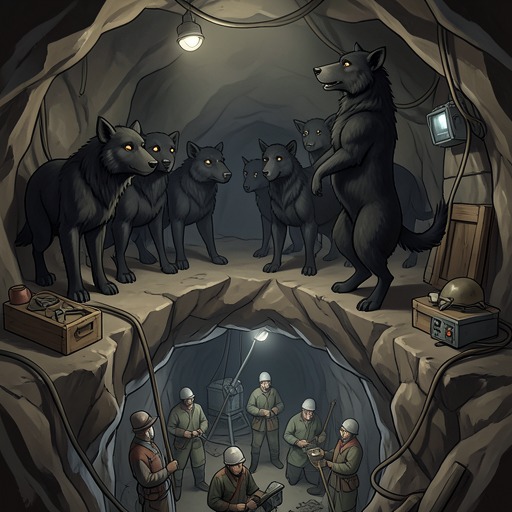
The word Rochai is a derogatory term for Ossam bred with wolves. Their mixed ancestry is made explicit when Suohl identifies them as Black Wolves crossed with Ossam, and Cheehana later names the same combination in a discussion of the Ahfal Oma’s hunting dogs. In the family’s first encounter with one of the animals, its wolf-like build is offset by different ears and jaw and a streak of light gold along its back; the distinction initially makes it difficult to identify as one of the Black Wolves.
The naming carries a cultural judgment. Aquafaese consider Rochai intelligent and prize them as hunting dogs. Van’s people, by contrast, sometimes breed dogs with wolves but would never use an animal with Ossam blood for hunting. Ohma’s question about whether the apparent Rochai must have a master, or might be corrupt hybrids without one, shows that identifying the animal also raises the question of human control.
Encounter and Recognition
After a night attack, Van stands over a dead animal, and Yoki observes that it is not one of the Black Brothers. Ohma, who had avoided looking at the carcass, examines it and agrees. Its resemblance to a wolf is clear, but its differing features leave its identity uncertain until Ohma asks whether it is a Rochai. The encounter links the animal’s unusual appearance to the distinction between a Black Wolf and a wolf–Ossam cross.
The question of whether these animals have a master becomes more consequential when Van recalls a figure at the forest’s edge holding reins of light. Later, Suohl tells Van that he saw him running with Rochai during the incident, identifying the animals as Black Wolf–Ossam crosses. The sequence moves from visual uncertainty about a carcass to recognition of the hybrids as part of an encounter involving Van and his daughter.
Hunting Dogs and Tradition
Rochai are not merely wild-looking hybrids in the later account: they are exceptionally capable hunting dogs. Tomasolle identifies the dogs as the reason for their owners’ effectiveness, and Cheehana specifies that the Ahfal Oma call the Rochai a gift from Kinma. Her explanation rests on an old story rather than on a claim that she has direct knowledge of the animals’ origin.
Cheehana recites Kinma’s rule for dealing with dead horses: burn a horse that dies well, lest wolves dig it up and learn the taste of horse flesh; bury one that dies of sickness so that the wolf suffers and will not want to eat horse again. In this tradition, the Rochai’s wolf ancestry is not only a matter of breeding or hunting skill. It is interpreted through a religious account of horses, wolves, and the god Kinma.
Ecology and Contrast
The book places Rochai alongside other human-animal relationships without treating all hybridization as equivalent. Van’s people may breed dogs with wolves, yet draw a firm boundary against using Ossam-blooded animals for the hunt; Aquafaese hunting practice and Ahfal Oma religious language instead give Rochai a valued place. The same crossbreed can therefore be a skilled companion, a stigmatized kind of dog, or a source of alarm, depending on the culture and circumstances.
That contrast sits beside Van’s practical knowledge of Pyuika. He understands how close bonds shape their behavior, how separation can make them lonely, and how their seasonal movements and feeding needs affect herding. Against that attentive knowledge of animals as particular creatures, the dispute over Rochai shows how inherited names and customs also shape whether people approach an animal as companion, danger, or divine gift.